CHOOSE YOUR STATE. TRAIN YOUR SIGNAL.
A private, goal-focused training session to practice attention, regulation, or performance with real-time feedback.
BOOK MIND QUESTProgram Overview
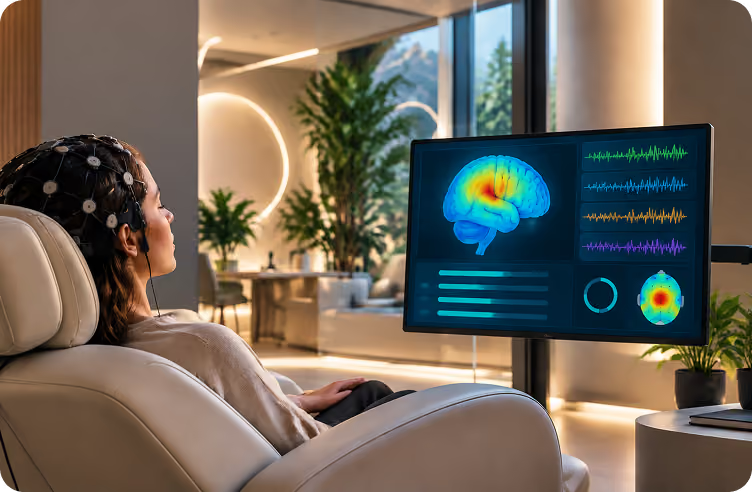
Mind Quest is a precision neuro-lab for clarity, calm or cognitive reset in 30 or 60 minutes. Whether you are overwhelmed, under-focused, emotionally overloaded or simply out of rhythm, this short-form training is designed to help you notice and practice shifts you can recognize and apply.
Each session adapts to your real-time data. Your brainwaves help set the course, and the lab responds.
Choose your state. Train your signal.
FOCUS
Attention · Recovery ·
Endurance · Transfer
Sustain and recover attention.
CALM
Downshift · Regulation ·
Recovery · Steadiness
Practice downshifting and self-regulation.
FLOW
Entry · Rhythm · Hold · Performance Transfer
Practice flexible, engaged attention.
Choose your session.
30 MINUTES — $90
A single private session for urgent clarity, recovery or performance needs.
60 MINUTES — $165
A more extended private session for deeper training, recalibration and integration.
Optional: Eight-session practice pathway, with each session booked and paid separately at the same rate.
Inside the Lab


Mind Quest Series
8 Sessions of Personalized Brain Training
Focus • Flow • Calm
Mind Quest is a personalized journey into the art and science of self-regulation. Through real-time neurofeedback and targeted mind-body training, you’ll explore how your brain responds to challenges, shifts between mental states, and develops greater flexibility over time.
Whether your goal is sharper focus, deeper calm, or more consistent access to flow, each session builds on what you discover about your own patterns.
Unlike a fixed training protocol, your Mind Quest adapts to you. Your goals, physiological feedback, and progress help guide each session.
Session 1Discover Your SignalOrientation & Personal Baseline
Your journey begins with understanding how your mind operates today.
We’ll identify your primary training goal—Focus, Flow, or Calm—and introduce you to real-time EEG neurofeedback. Through brief baseline recordings and guided exercises, you’ll observe how your brain responds to attention, relaxation, and mental activity.
This first session establishes a starting point for your personalized training journey.
Session 2Find Your FrequencyRecognizing Your Mental Patterns
What happens in your brain when you concentrate, relax, or become distracted?
Through guided neurofeedback exercises, you’ll begin recognizing the physiological patterns associated with your chosen goal.
You’ll explore how subtle adjustments in attention, breathing, or awareness influence your real-time feedback, discovering the connection between intention and physiological response.
The objective is awareness: learning to recognize the signals that accompany different mental states.
Session 3Train Your AttentionStrengthening Mental Control
Attention is more than concentration. It’s the ability to direct your mind and recognize when it has wandered.
Using targeted EEG training exercises, you’ll practice sustaining a desired mental state, noticing disruptions, and returning to your chosen focus.
Depending on your goal, training may emphasize maintaining attention, releasing unnecessary effort, or remaining mentally engaged without tension.
You’ll begin developing a practical skill: recognizing distraction and deliberately returning to your intended state.
Session 4Shift Your StateBuilding Cognitive Flexibility
A flexible mind can move between focused activity, creative openness, and restorative calm.
This session explores your capacity to transition between mental states through structured neurofeedback exercises.
You may practice shifting from active concentration toward relaxation, from mental fatigue toward alertness, or from effortful thinking toward a more fluid state of awareness.
The emphasis is on developing greater choice in how you respond to changing mental demands.
Session 5Strengthen Your SignalStability, Recovery & Self-Regulation
Recognizing a mental state is one skill. Maintaining it—and recovering when it’s interrupted—is another.
We’ll revisit your training patterns and introduce exercises designed to strengthen stability and recovery.
Through repeated feedback cycles, you’ll practice recognizing changes in your signal, making adjustments, and returning toward your desired state.
Your session observations may reveal emerging patterns in consistency, responsiveness, or the effort required to self-regulate.
Session 6Expand Your CapacityTraining Under Changing Conditions
Can you maintain your focus, calm, or flow when the conditions change?
This session introduces variations in training demands to explore how flexible your emerging skills have become.
Depending on your selected goal, you may work with attention challenges, transitions between tasks, guided imagery, or changing levels of stimulation.
The purpose is to move beyond isolated training exercises toward practical mental adaptability.
Session 7Make It Your OwnIntegrating Skills Into Everyday Life
Your training now moves toward personal application.
We’ll identify the exercises and strategies that have been most useful and explore how to apply them to real situations—studying, creating, performing, managing pressure, or recovering from demanding experiences.
You’ll practice recognizing early signs of mental drift or overload and selecting techniques that help you regain your preferred state.
The objective is greater independence: learning to use your skills beyond the Brain Gym.
Session 8Your Mind Quest BlueprintProgress Review & Personal Integration
Your final session brings your Mind Quest journey into perspective.
We’ll revisit your original training goals, review available session-to-session feedback, and compare relevant observations with your starting baseline.
Together, we’ll identify patterns of change, skills worth strengthening, and practices you can continue independently.
You’ll leave with a personalized Mind Quest Blueprint—a practical summary of your training experience and recommended next steps for sustaining your progress.
What You May Notice
Every brain responds differently. Mind Quest is designed to help you recognize and strengthen the mental states that support your personal goals. As your training progresses, you may begin to notice:
Sharper Focus
Greater awareness of distraction, improved attention stability, and an increasing ability to return to what matters.
Deeper Calm
More familiarity with the sensations of relaxation, reduced subjective mental noise, and greater confidence in your ability to settle after challenging moments.
More Accessible Flow
An increased ability to recognize the conditions that support creative engagement, effortless concentration, and immersion in meaningful activities.
Greater Mental Flexibility
Improved awareness of how to transition between active thinking, relaxed attention, and restorative states.
Faster Recovery
A growing ability to recognize when you’re mentally overloaded or off balance and apply techniques to regain steadiness.
A More Personal Understanding of Your Mind
Perhaps the most valuable discovery is learning how your own brain responds—and developing a greater sense of agency in your relationship with it.
Your Signal. Your Practice. Your Progress.
Mind Quest is not about forcing your brain into a perfect pattern. It’s about learning to recognize, influence, and work with your natural rhythms.
One session offers an opportunity for discovery. Eight sessions create a structured opportunity to practice, observe, and refine those skills over time.
Individual experiences and outcomes vary. Mind Quest is educational brain training, not a medical diagnosis or treatment. Physiological measurements and progress summaries depend on the training methods and equipment used during your sessions.